
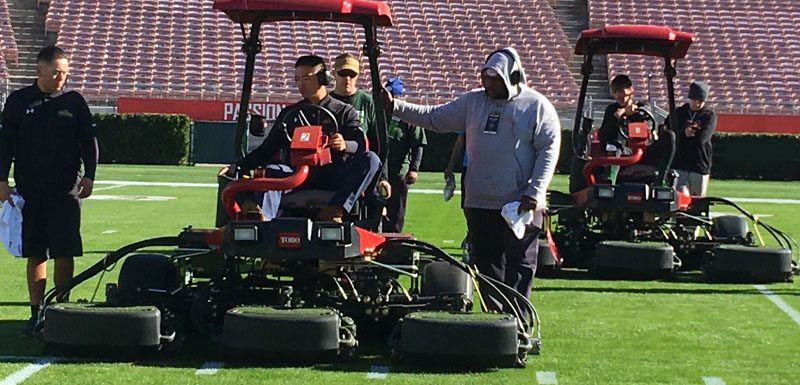
By now, summer has taken its toll on nearly every turf surface.
 Repeated athletic traffic, soil compaction, reduced turf density, root-zone stress, and increased disease and pest pressure have all played a role in summer stress. As agronomists, whether we manage a sports complex or a golf course, we understand one simple truth:
Just because the turf is green doesn’t mean it is 100% healthy.
One common thread between golf courses and sports fields is the challenge of managing traffic stress. And traffic stress is about much more than footprints. We have to consider the mechanical stress created by daily equipment use, as well as how soil moisture conditions can intensify that stress. For sports field managers, traffic can also come in the form of everyday wear and tear, games, practices, and even concerts.
Concerts, in particular, can have a major impact on how quickly a field recovers. Stage construction, heavy equipment, and increased pedestrian traffic can create significant compaction and physical damage to the playing surface.
The result can become a domino effect:
Traffic → compaction → reduced pore space → reduced water infiltration and air exchange → weaker rooting → weaker turf → slower recovery.
That is why managing traffic stress should be about more than simply repairing damage after it occurs. It should be about identifying where that stress is occurring and planning ahead.
Start looking beyond the green
It is a good habit to document areas experiencing higher levels of stress that may require additional attention.
As you implement your fall program, take the time to walk the field and evaluate what you are seeing.
Look for:
- Declining turf density
- Compacted soil
- Areas holding water longer than usual
- Increased weed pressure
- Areas receiving repeated traffic
- Upcoming games and events that could increase field stress
Your event calendar can be just as important as your agronomic calendar.
Knowing where and when traffic will occur allows you to begin thinking proactively rather than reacting after the damage has already been done.
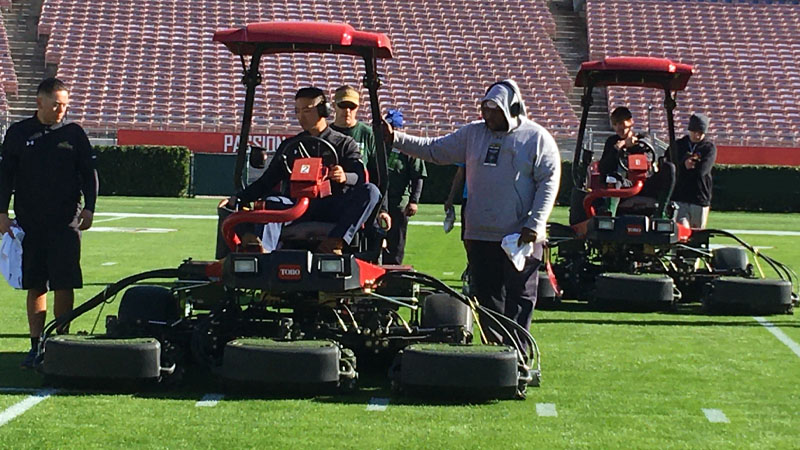
The summer-to-fall transition
For Bermudagrass sports fields, the transition from summer into fall is a critical period. You are still dealing with challenging weather patterns while beginning your fall pre-emergent program and maintaining proper fertility. At the same time, you want to avoid creating excessive flushes of growth as the plant begins naturally slowing down.
This is where our fertility strategy becomes especially important. As growth begins to slow, fertility applications should be focused on maintaining plant health and building a strong carbohydrate base that will help the turf enter dormancy in the best condition possible. The goal isn’t simply to keep the field green as long as possible.
The goal is to build a healthy plant that can withstand the coming winter and transition successfully into the next growing season.
When traffic meets a slowing plant
Now is the time to start thinking about next spring.
Traffic stress late in the summer can leave a weaker plant heading into the fall. While Bermudagrass is actively growing, recovery is generally faster and easier. But as temperatures and day length decrease, growth and recovery naturally begin to slow. That means the margin for error gets smaller. Every decision we make during this period can ultimately influence how that field comes out of dormancy.
If we spend the entire summer beating up a field and then continue to subject it to heavy traffic as temperatures decline, we can enter winter with:
● Thin turf
● Damaged crowns
● Poor rooting
● Compacted soils
● Bare areas
● Greater winter weed pressure
And once those problems are present going into winter, recovery becomes much more difficult.
Build the stand before you need it
As agronomists, we know that one of our best defenses against weed pressure is a strong, dense stand of turf. The same principle applies to traffic stress. A healthy, dense, well-rooted field is going to have a much better chance of recovering from the demands placed on it than a field already weakened by compaction, poor rooting, and declining density.
The summer-to-fall transition is therefore more than just another change in the calendar. It is an opportunity to assess the damage, adjust the program, manage traffic, and prepare the plant for what comes next. The work we do now may not always be visible immediately.
But when spring arrives and Bermudagrass begins breaking dormancy, the condition of the field will tell the story. What we do in the fall helps determine what we get in the spring.

