
When researchers at the University of Arkansas developed an automated spraying platform to target weeds in dormant Bermudagrass, it is unlikely any of them envisioned using a second-hand jogging stroller as the delivery vehicle. With that said, a used stroller turned out to be the perfect platform for testing the spraying technology developed by researchers at the Arkansas Agricultural Experiment Station.
With automation quickly establishing a foundation in turfgrass management, scientists in Fayetteville identified a potential need for the market.
University extension specialist Jason Davis, Ph.D., who has been working in autonomous spraying in soybeans, approached Wendell Hutchens, Ph.D., assistant professor in plant pathology, about whether technology that minimizes herbicide use and reduce costs associated with spraying weeds in row crops could be adapted for use in turfgrass.
Davis is assistant professor in the department of crop, soil and environmental sciences and a remote-sensing and pesticide-application specialist for the Division of Agriculture’s Cooperative Extension Service.
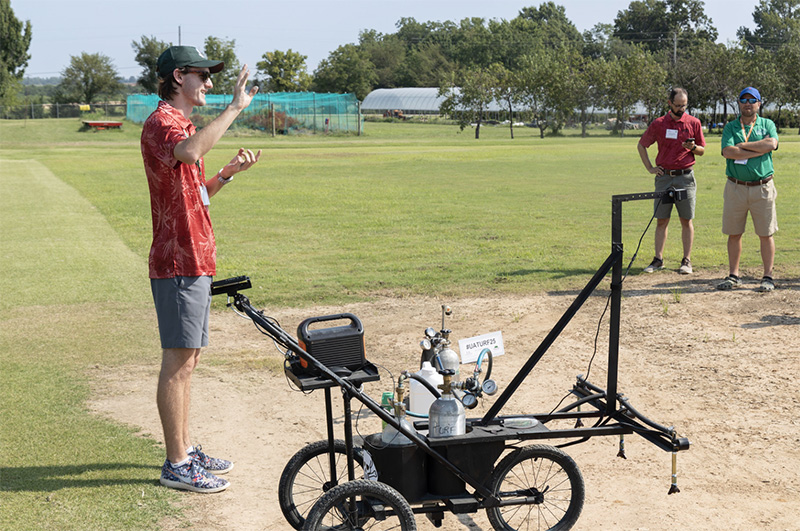
Researchers decided to examine spot spraying glyphosate on weeds in dormant Bermuda by developing a system that identifies invasive weeds by color as the green weeds stand out in contrast to brown warm-season turf.
As work toward refining the technology advanced, scientists searched for a way to deliver herbicide across the turf and settled on attaching the spray unit to a used jogging stroller bought at a yard sale for $3.
Building the system cost about $850 in parts and combines a camera, custom software and electronically controlled spray nozzles that detect and spot-spray green winter weeds amid the dormant, brown Bermudagrass. Weed detection thresholds can be adjusted in real time on a touchscreen monitor.
Developing the system primarily was the work of Hutchens and former Arkansas master’s student Sam Kreinberg who has moved on to Virginia Tech to pursue a doctorate degree.
This technology is about to bear fruit, and we are on the cusp of having this technology available in turfgrass. It’s an exciting time to be on the front edge of technology.
The project began in 2023 at an Arkansas field day when Davis approached Hutchens about adapting row crop technologies for use in turfgrass and coincided with Kreinberg’s time as a graduate student at Arkansas. Kreinberg, who had several years of experience working on golf courses, earned a bachelor’s degree in mathematics and had a background in software-development experience.
Rather than relying on machine-learning models that require thousands of labeled images for training, the team developed a simpler system based on the dark green color index, or DGCI, a vegetation index developed by Division of Agriculture researchers in 2003.
The system processes 30 images per second from a camera mounted above the sprayer. When the number of green pixels exceeds a threshold, the software activates a spray nozzle.
“It looks for the color of the weed, more than the shape,” Hutchens said. “This is just a prototype. We were looking for something that could trigger the solenoid and activate the sprayer and then turn off when the weed is out of the frame of the camera.”

In testing at Arkansas, the system maintained at least 90 percent weed detection in three of four trials and reduced herbicide use by as much as 62 percent compared with a conventional broadcast application. The system also proved to be faster and more efficient than hand-spot spraying with a backpack sprayer.
Moving ahead, the goal is to improve and perfect the technology, including identifying and developing a delivery platform that does not include a child’s stroller, and get the technology licensed by the university to help superintendents and sports field managers save money and be more efficient in managing weeds in dormant Bermudagrass, Hutchens said.
“We are not trying to compete. We are trying to offer something different,” Hutchens said. “This technology is about to bear fruit, and we are on the cusp of having this technology available in turfgrass. It’s an exciting time to be on the front edge of technology.”

