
For years, the name Pinehurst has been synonymous with championship golf, most notably the U.S. Open Championship. For much of that time, the name Paul Jett, CGCS, was synonymous with Pinehurst.
Jett, the host superintendent of the U.S. Open in 1999 and again in 2005 at Pinehurst, has been named the recipient of the Carolinas GCSA’s Distinguished Service Award.
Known for providing championship conditions for the world’s best players, Jett, now 61, also played a key role in another important program in the Carolinas. He was president of the Carolinas GCSA when it launched the Rounds 4 Research program in 2009. The annual online auction sells donated tee times at some of the country’s top golf courses to help fund turfgrass research.
Honestly, it’s been like the boardroom of a Fortune 500 company. We’re not talking about how to grow membership numbers, or selling booth space at our conference and trade show. It’s been much bigger, broader stuff. Water, taxes, research, economic impact. It’s a new realm.
“Paul spent literally countless hours on the phone that first year – and the second year too – communicating personally with superintendents to secure donations for the auction,” said Tim Kreger, Carolinas GCSA executive director. “You have to remember, it was a brand-new concept back then. The work he did, one phone call at a time, established the auction’s credibility and a momentum that we have been riding ever since.”
Rounds 4 Research has since become a national program that has raised more than $5 million. More than 1,200 rounds will be offered in this year’s auction which runs from April 20 to 26.
Now a territory manager with Triangle Turf and Ornamental, Jett was a key player in the association becoming the first GCSAA affiliated chapter to own its headquarters. As president then in 2008, he spearheaded the search for the property, and even helped unload furniture and equipment on move-in day.
His year as president came during a real-estate fueled recession. His work then in concert with the North Carolina Alliance for Golf, helped hold off government efforts to initiate a new tax on every round of golf. He also helped start a program at Clemson and North Carolina State universities to help golf courses measure water-use efficiency.
During his year as president, Jett described association board meetings as centering around the business of golf.
“Honestly, it’s been like the boardroom of a Fortune 500 company,” he said then. “We’re not talking about how to grow membership numbers, or selling booth space at our conference and trade show. It’s been much bigger, broader stuff. Water, taxes, research, economic impact. It’s a new realm.”
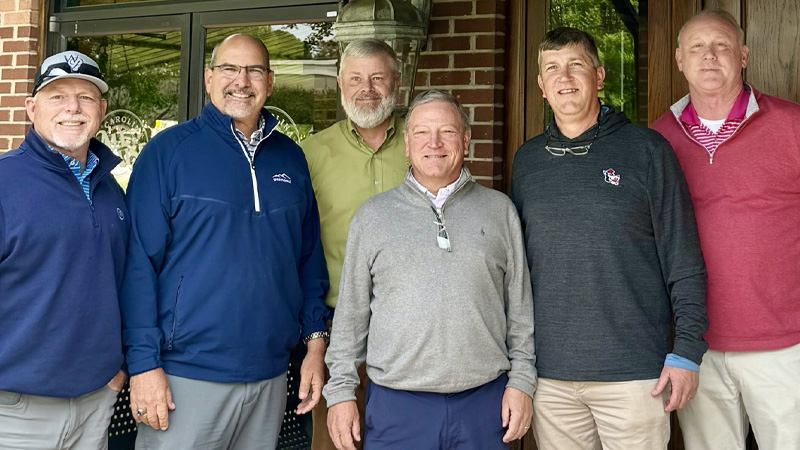
Jett will be presented with what is the association’s most prestigious award at its annual Conference and Trade Show in November in Myrtle Beach.
In other association news, the Carolinas GCSA has eclipsed the million-dollar mark in support of turfgrass research funded by Rounds 4 Research. The milestone came with recent pledges to Clemson and North Carolina State universities to help create endowed golf-specific research faculty positions.
“This is a historic milestone and one that every one of our members should be extremely proud of,” Kreger said. “Remember, this program launched right here in the Carolinas in the midst of the Great Recession when traditional funding sources were drying up.
“Instead of complaining, we committed, as golf course superintendents do at their facilities every day, to be part of the solution. There’s now more than one million pieces of evidence to say we’re achieving that goal.”
In March, the Carolinas GCSA committed $100,000 each to Clemson and NC State over five years. NCSU NC State is working to raise $2.5 million to establish a Distinguished Chair in Golf Turf Management. Clemson’s target is $1 million for a Distinguished Professorship in Turfgrass.
It was Kreger’s own inspiration and the support of the Carolinas GCSA board that led to the Rounds 4 Research launch in 2009. Golf facilities donate tee times at some of the most exclusive clubs that are auctioned online every April.
Following the auction’s early success and adoption in other regions including Georgia and Texas. The GCSAA took over the program in 2012 and has since raised nearly $5 million nationally.
This year’s auction runs April 20-26.

