
What began as an idea way to clean wastewater has evolved into a way to help provide turfgrass managers with a high-quality irrigation source and maybe even reduce the need for further inputs.
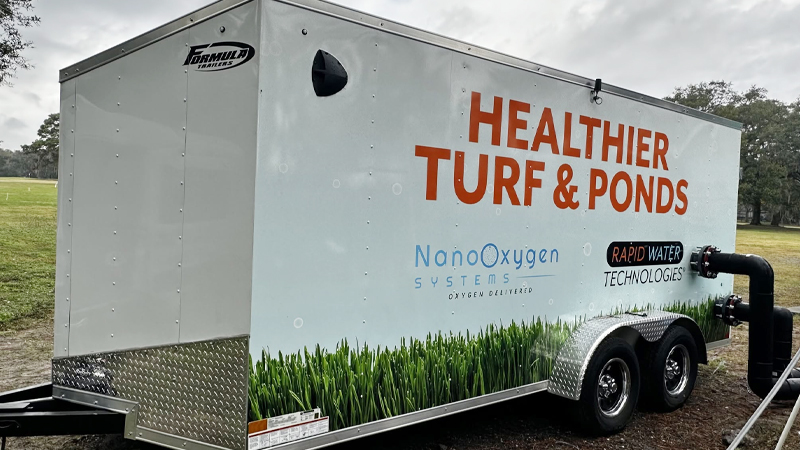
Nano Oxygen Systems utilizes nanobubble technology to increase the amount of dissolved oxygen in a water body. Invisible to the naked eye, nanobubbles are ultrafine gas bubbles that are less than 200 nanometers in size. The Nano Oxygen Systems process produces water containing about 15 parts per million of dissolved oxygen. By comparison, that is twice the amount of dissolved oxygen that is found in rainwater, says Nano Oxygen Systems founder Ron Pote. The water at the bottom of many irrigation ponds and lakes on golf courses can be completely absent of oxygen.
“The characteristics of these bubbles is that, because they don’t float, when you put them in a lake or a pond, they basically fill the water column,” Pote said. “And they allow us to get oxygen, or aerobic conditions in the bottom of the pond, which then allows us to break down the muck. And the carbon that’s part of the muck gets to be used for fuel for the bacteria. So they use the nutrients, so we starve the algae, basically.”
The dissolved oxygen in water promotes bacterial growth, and the microbes feed on algae that sucks oxygen from the water.
He asked if I had tested for copper. I never thought of that. Our copper levels were 20 times above where we should have been.
A chemical engineer by trade, Pote worked for years in the paper industry. After leaving that field, he launched his own environmental wastewater treatment business. Eventually, he thought that large amounts of ultrafine bubbles could improve water quality by infusing more oxygen into the water column.
“After I left (the paper industry) in 1998, I started an environmental business, and we did a lot of natural bio-stimulation of wastewater plants,” Pote said. “In 2019 we were starting to fight algae in these polishing ponds in wastewater plants. And I did some research and, I was never really satisfied with aeration technology, because it was high energy, big blowers blowing bubbles in the water. I found in China, Japan and South Korea they were actually using it for aquaculture.”
If nano technology could help clean wastewater and was being used in food production, he figured better quality water might have other benefits, such as better turf quality.
There is little question that ultrafine bubbles can help improve dirty water. But does that technology lead to positive effects on turf? Anecdotal evidence says yes. Pote is investing in pending university research at the University of Arkansas for proof.
Early nano bubble technology created oxygenated ultrafine bubbles by a process of water passing through a series of membranes. However, algae and other impurities in the water clogged those systems.
Today’s technology is more advanced.
Gas bubbles are created as water passes over a series of perforated discs, churning along the way through a process called cavitation.
“There’s actually four patents associated with this. So what happens is the water flows through this pipe,” Pote said. “Inside the pipe are a series of plates, and every plate has got holes in it. It does that in different geometries multiple times until all of the gas is basically transferred to the water.”
These bubbles are too small to float, and since they do not, when put into a lake or pond the result is an increase of dissolved oxygen that oxidizes and starves algae, says Pote.
While university research gets under way, anecdotal evidence indicates that water infused with nano bubbles can have similarly positive benefits when applied to turf.
Ralph Kepple, CGCS, was an early adopter of the technology while at East Lake Golf Club in Atlanta. Eventually, he became such a believer in the benefits of nanobubbles in irrigation water that he joined Pote’s company.
Algae was a recurrent problem at the home course of The Tour Championship, and it was in 2017, when a foul smell emanated from the club’s irrigation pond. Further investigation revealed that sewage leaked into a pond off property and made its way onto East Lake’s impoundment after a hurricane passed through Georgia.
“My phone was ringing off the hook,” Kepple said. “The smell was so bad you couldn’t stand to be back there.”
Kepple reached out to a vendor to remove the scum until he learned of the source. Applications of copper sulfate helped — for a while.
That winter, East Lake’s greens exhibited thinning turf as well as a healthy infestation of algae. He reached out to the late Bruce Martin, Ph.D., at Clemson University for advice.
“He asked if I had tested for copper. I never thought of that,” Kepple said. “Our copper levels were 20 times above where we should have been.”
Mark Hoban, superintendent at Rivermont Golf Club in suburban Atlanta, already knew Pote and what he was up to and introduced Kepple.
After a couple of iterations of Pote’s technology, Kepple was a believer. In 2022, Kepple treated his pond eight times for algae. A year later, he treated the pond exactly once.
“And we didn’t need it,” Kepple said. “I did it once right before the (Tour Championship) just to make sure it didn’t show up.”
Said Pote: “I think Ralph was the first person who got me thinking about how this could affect turf. … We would spend hours together along the lake trying to figure out how to knock down the algae. I put biochar socks on the inlets to keep the nutrients from washing into the lake from around Atlanta. I didn’t know anything about agronomy, and he said you know, I think if you could get oxygen into the water then get it into the root zone, this could have a strong effect.
“We just kept figuring it out.””
By January 2025, Kepple was so convinced of the benefits of the technology he joined Nano Oxygen Systems as its director of operations.
“The oxygen gets into the soil, and the soil biology changes completely,” he said. “The roots develop. They are longer, and there is more bio-mass.”
The characteristics of these bubbles is that, because they don’t float, when you put them in a lake or a pond, they basically fill the water column.
Nano Oxygen also injects carbon dioxide to help control pH. When carbon dioxide bubbles dissolve, they form carbonic acid, which releases hydrogen ions and effectively lowers the pH.
John Reilly, director of agronomy at Longboat Key Club near Sarasota, Florida, already was using a system of injecting compressed oxygen into his well-fed irrigation system when he checked out the Nano Oxygen Systems technology.
He has detected increased oxygen levels in the water at Longboat Key, and even improved turf quality. What he can’t prove is what is causing a healthier Paspalum plant.
He believes in what he is seeing that he continues to use two compressed oxygen systems and two Nano systems.
“I’m a ‘show-me guy,'” Reilly said. “I could never figure out what was leading to us being able to use less fungicide. Is it the bubbles, or did we just happen to have a really good year? All the evidence we have is anecdotal.”


Thanks John for writing this. We have a huge hill to climb to teach and share water quality information and impact on agronomy. Nearly 30 systems now are performing very well from FL, to NY, to WI, to TX, to AZ, to CA and many courses in between. We keep learning and helping courses finally solve their water quality issues. Check out our YouTube channel for video interviews from superintendents that are making a difference in their water quality and courses.
https://www.youtube.com/@user-NanoOx