
The newest golf course to open in South Carolina is anything but traditional. Then again, tradition was hardly golf course architect David Zinkand’s intent when he designed The Scurry, a 12-hole short course at the Chechessee Creek Club in Okatie, South Carolina.
The result is a course designed to feel distinctly different from the club’s 18-hole design.
The course, which opened Sept. 1 for member play, is a collection of par-3s and short par-4s winding through Lowcountry oaks, wetlands and native growth.
The property’s 18-hole course, a 2000 Bill Coore-Ben Crenshaw design, is ranked among the top 20 golf courses in South Carolina by Golf Digest. With The Scurry, Zinkand’s intent was to create a fun and challenging golf experience that embraces the natural rugged environment and preserves and incorporates native vegetation.
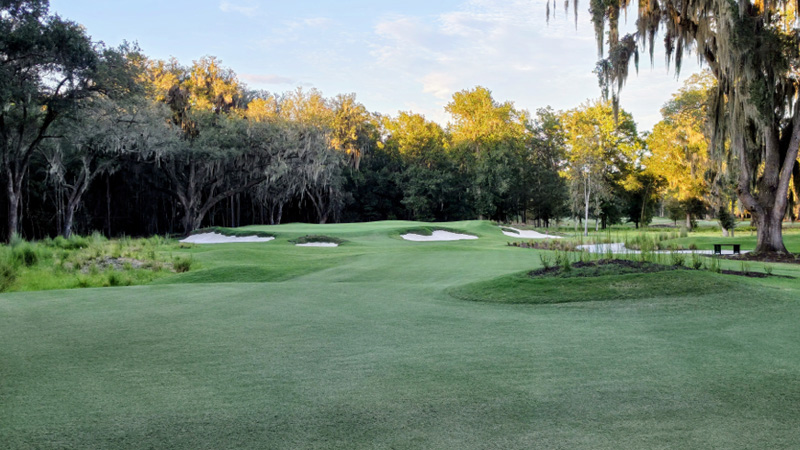
In an era where club and ball technology forces many traditional layouts to find challenges in increased length off the tee, Zinkand used angles, contours, hazards and strategic choices to provide a fun and challenging experience. Some of that strategy comes in the way of expansive areas of short grass surrounding the greens to give golfers the option to employ a ground game throughout The Scurry’s layout.
Zinkand worked with the likes of Coore and Crenshaw, Hanse Golf Design and Arthur Hills/Steve Forrest and Associates before launching his own Zinkand Golf Design in 1999.
Throughout The Scurry, Zinkand used the area around the greens as an extension of the putting surface. The many bumps and ridges can be utilized to feed balls toward pins or penalize players.
Because of the many strategic options and angles available to golfers, The Scurry does not have an official published yardage.
“The course is really about options,” Zinkand said. “You can challenge a hazard and create a better angle, play away from trouble and accept a more difficult approach or use the contours around the greens to your advantage. We wanted those decisions to be fun for every player, regardless of ability.”
The course begins with a five-hole loop of par 3s of varying length. Its expansive corridors make the routing forgiving for beginners, higher-handicap players and youth golfers, while changes in length, orientation and green design simultaneously offer challenges to better golfers.
The remaining seven holes are more challenging and put a premium on strategic shot-making. The sixth is a short par 4 with live oaks along the inside of the fairway, while No. 7 has a forced carry over a wetland to a high green.
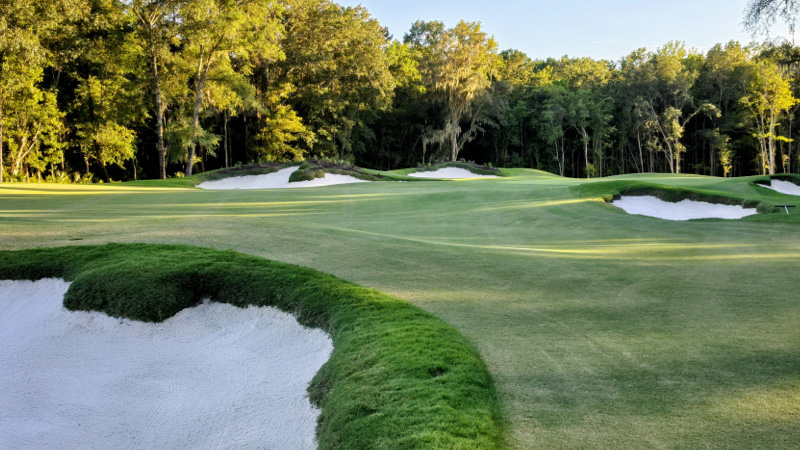
No. 8 crosses another wetland to a punchbowl green guarded by a large front bunker. The ninth filters to a bunkered, domed green, while the No. 10 ends at a contoured green with a pronounced false front. The penultimate 11th hole offers plenty of room from the tee, but liberal bunkering creates several strategic options into the green. The Scurry ends with a par 3 over native vegetation to a green tucked into a towering pine grove.
“The low-mown areas allow the ground to become part of the strategy,” Zinkand said. “Sometimes the contours help you and sometimes they don’t. They create opportunities to use imagination rather than simply hitting another conventional pitch or chip.”
The Scurry also exhibits Zinkand Golf Design’s philosophy of “sense of place.” by placing particular emphasis on the landscape outside the playing area. The design preserves native Lowcountry vegetation while creating varied habitats and ground formations intended to increase ecological diversity and reinforce the site’s natural character, Zinkand said.
To that end, The Scurry incorporates a carnivorous plant bog near the eighth tee that includes pitcher plants, Venus flytraps and other species.
“It is definitely something golfers don’t expect to see on a golf course,” Zinkand said. “But it fits the character of the site and the experience we wanted to create. There are a lot of moments where the natural landscape is doing something interesting, and the bog is probably the most memorable.”
The result is a course designed to feel distinctly of its place while offering a different kind of challenge from the club’s existing 18 holes.

